Build or Buy? The IT Reality Behind AI Personalization
Author:
Anjali Yakkundi
Build or Buy? The IT Reality Behind AI Personalization

Date:
October 30, 2026

Read time:
7 minutes

Anjali Yakkundi
Table of Contents

You've got the customer data, the developers, and maybe even a few predictive models already in the works.
So why bring in another vendor?
It’s a fair question, especially when IT teams are under pressure to consolidate technology, control costs, and make better use of existing investments.
But building an AI decisioning solution for a handful of campaigns is very different from scaling AI-driven personalization across millions of customer interactions, channels, and markets. And the initial development is only one part of the ongoing commitment.
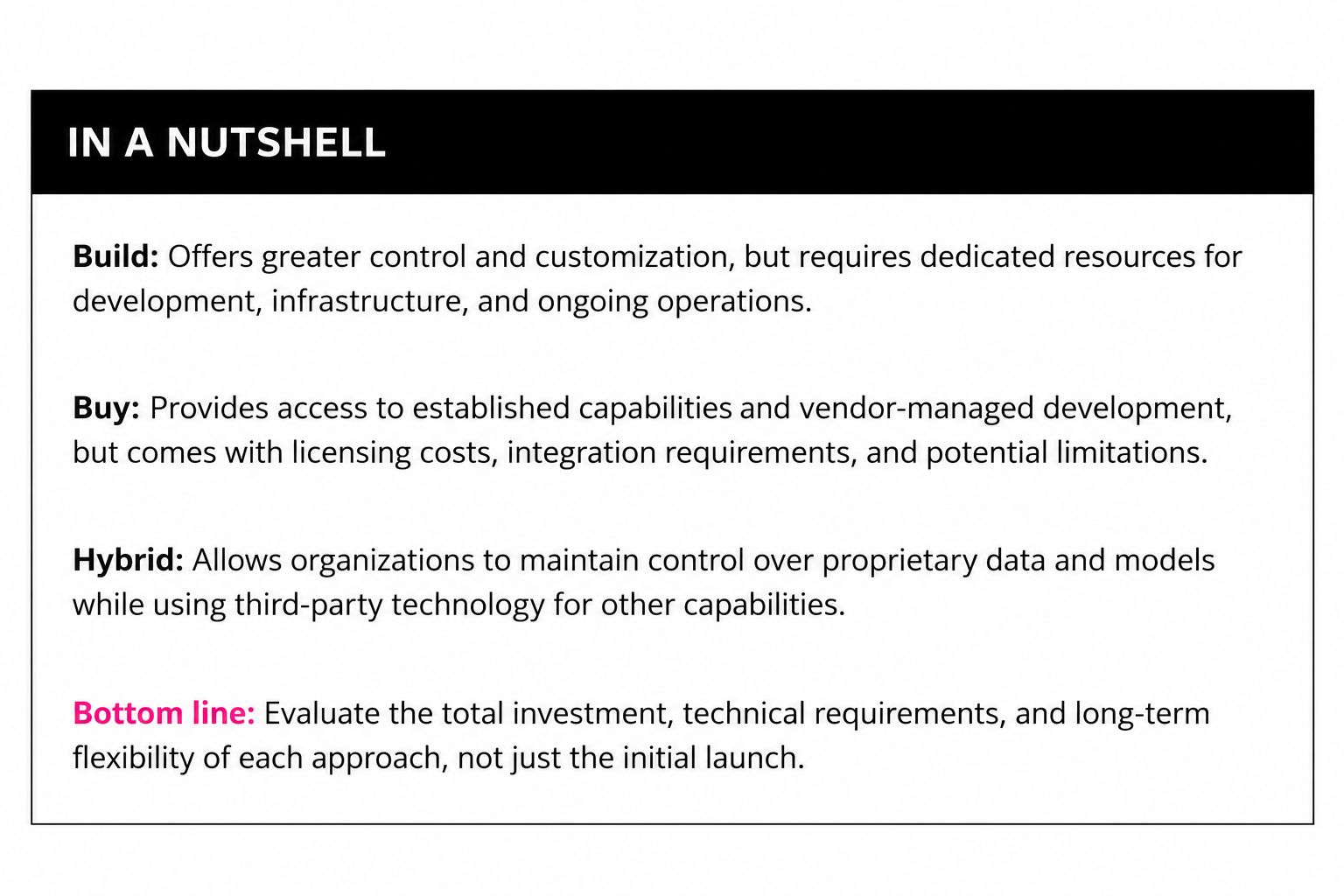
Before deciding whether to build or buy, there are a few important considerations that deserve a closer look.

1. Understand What You’re Building (or Buying)
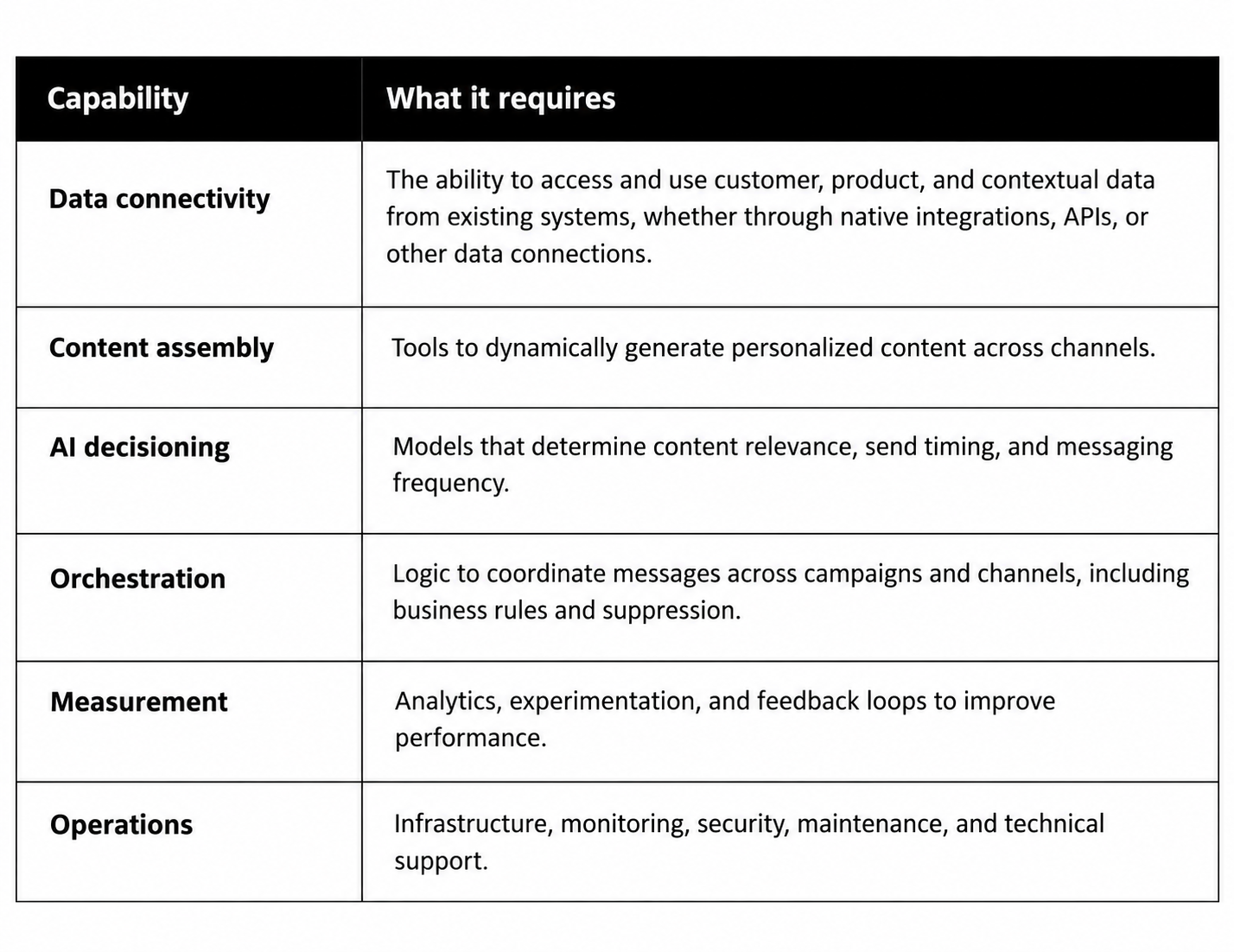
AI decisioning for personalization requires more than a model that predicts which content a customer is most likely to engage with.
Depending on your goals, you’ll need technology that connects data sources, makes decisions, assembles content, coordinates experiences across channels, and measures performance.
Here’s what that can involve:
It's also important to consider who will manage these capabilities day to day. Giving marketers the ability to create and update personalized experiences independently can reduce ongoing requests to engineering teams.
Not every organization needs to develop or purchase all of these capabilities. You may already have strong internal infrastructure or proprietary models you want to continue using. Look for solutions that can work alongside your existing technology, connecting with your data sources, marketing platforms, and internal systems without requiring you to replace what's already working.
The key is establishing what your existing technology can support, where the gaps are, and how each option would address them.
Otherwise, you risk comparing the cost of a limited internal build against a much broader commercial platform.
2. Calculate the Full Cost, Not Just the Upfront Investment
An in-house build might appear less expensive than purchasing a platform, particularly if you already have the necessary engineering resources.
But development costs only tell part of the story.
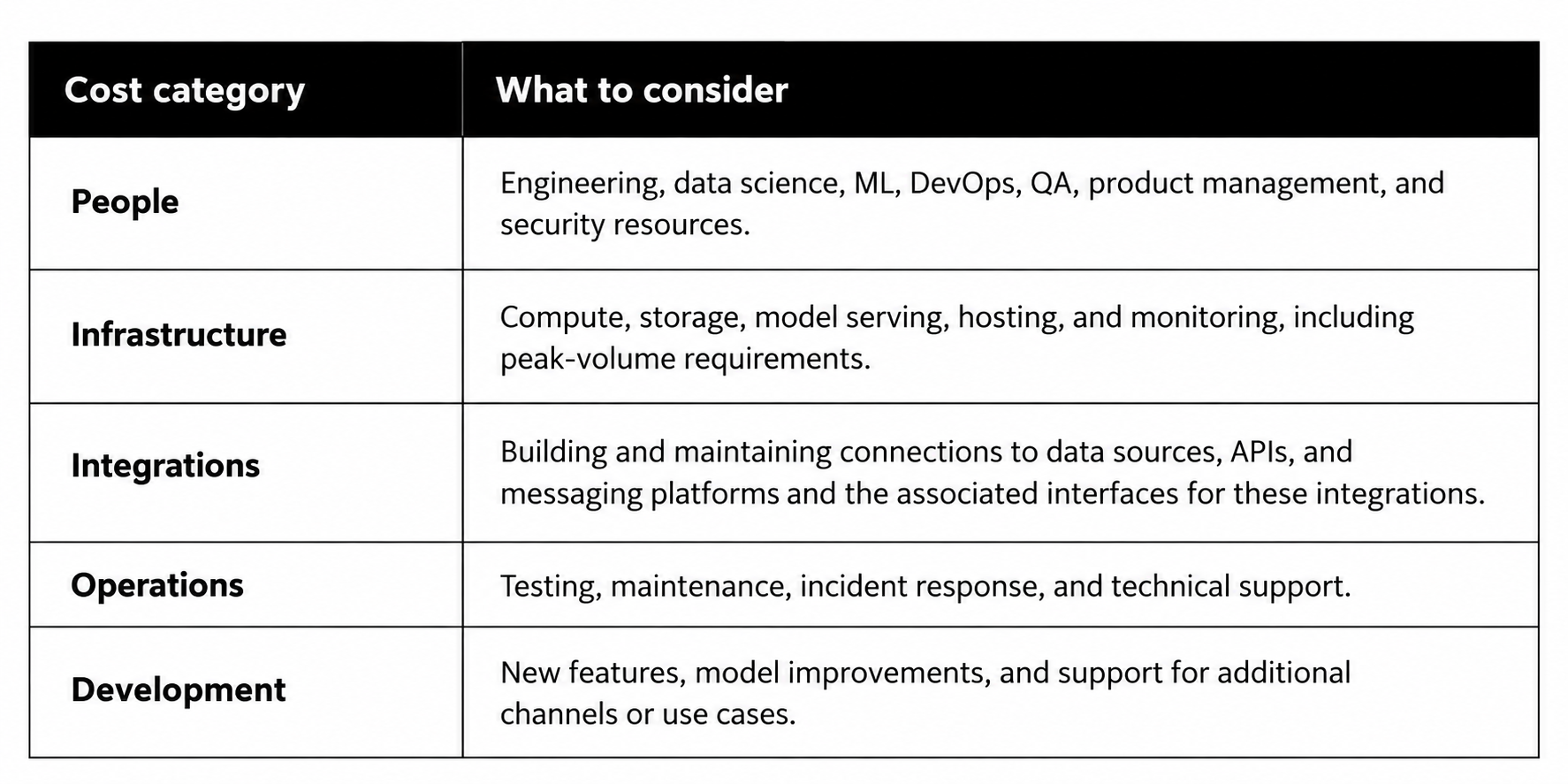
There’s also the opportunity cost.
If your engineers are responsible for maintaining an internal AI decisioning and personalization solution, what other projects will they have less time to work on?
Consider the ongoing development support marketers will need, too. If every new campaign, content variation, or data connection requires engineering involvement, those requests can add up quickly.
Buying a platform doesn’t eliminate internal costs either. Your team may still need to manage implementation, integrations, data governance, and vendor oversight.
A three- to five-year total cost of ownership comparison will tell you much more than an initial development estimate or vendor quote.
3. Evaluate Scalability, Performance, and Flexibility
A successful proof of concept doesn’t necessarily mean a solution is ready for enterprise-wide deployment.
As personalization programs grow, the technology needs to support more customer interactions, additional data sources, new channels, and increasingly complex business requirements.
Focus on three areas:
⭐ Performance at scale
Can the solution handle your expected volume without compromising latency, availability, or reliability?
This becomes particularly important during peak marketing periods, when even a brief disruption can affect a significant number of customer interactions.
⭐ AI model performance
Building a predictive model is one thing. Keeping it effective requires reliable data pipelines, monitoring, experimentation, and ongoing optimization.
Your team will also need to account for model drift, changing customer behavior, and the infrastructure required to deliver predictions in real time.
Beyond maintenance, there's the question of how your models will evolve. Traditional predictive models have supported next-best-action decisions for years, but machine learning continues to advance. Techniques like multi-armed bandits and transformer models offer additional ways to balance immediate performance with long-term customer engagement.
It's also important to understand what the models are optimizing for. Some solutions focus on predicting the next best action, while others can evaluate available content to determine which experiences are most relevant to individual customers.
Keeping pace with these advancements requires ongoing investment and expertise. If you're evaluating a vendor, understand how its models are maintained, how performance is measured, how new techniques are incorporated, and whether you can use your own predictive scores.
⭐ Flexibility as requirements change
Your technology needs will evolve.
You may want to introduce a new channel, connect additional data sources, or expand personalization into other business units. Look for solutions that can accommodate those changes without requiring extensive development work.
For example, Movable Ink offers more than 100 pre-vetted integrations with commonly used platforms, along with a guided interface for building custom integrations with existing internal systems.
If you're building internally, think about the development resources needed to support these changes over time. If you're evaluating a vendor, look at its integration flexibility, API capabilities, and product roadmap.
Your solution should be able to support your immediate needs while giving you room to grow.
4. Account for Security and Operational Responsibility
Whether you build or buy, personalization technology needs to meet your organization's security, privacy, and reliability requirements.
Building internally gives your team direct control over the architecture and security measures, but also makes your organization responsible for implementing, monitoring, and maintaining them.
With a vendor, some operational responsibilities are handled externally, but your team still needs to evaluate the provider's security practices and how the platform interacts with your existing systems.
Your evaluation should cover:
- Security and compliance: Access controls, encryption, audit logging, relevant certifications, and regulatory requirements.
- Data governance: How customer data is accessed, processed, retained, and deleted, including how existing permissions and business rules are maintained.
- Reliability: Uptime history, peak-volume performance, recovery procedures, and service-level commitments.
- Incident response: Monitoring, escalation processes, support availability, and ownership when something goes wrong.
If you're evaluating a vendor, request supporting documentation such as SOC 2 Type II reports and relevant ISO certifications.
If you're building internally, account for the additional time, resources, and expertise needed to meet these requirements and maintain them as your solution evolves.
5. Know When Building Makes Sense
There’s no universal answer to the build vs. buy decision.
Building internally may be the right approach if your organization has highly specialized requirements, established machine learning and engineering resources, or a strong track record of developing and launching similar technology.
A purpose-built platform may make more sense if you're looking to expand your capabilities without dedicating significant resources to developing and maintaining the underlying technology. It can also help reduce ongoing costs and the risk of knowledge gaps when key team members leave.
And it doesn't have to be one or the other.
Many organizations benefit from a hybrid approach, maintaining ownership of their data, predictive models, and business logic while using external technology for specialized capabilities like content personalization and AI decisioning. Established vendors may support this type of environment, giving organizations the flexibility to expand their capabilities while maintaining control over the areas that matter most to their business.
Ultimately, the decision comes down to where your organization needs direct control, what your existing teams can realistically support, and which investments make the most sense for your business.
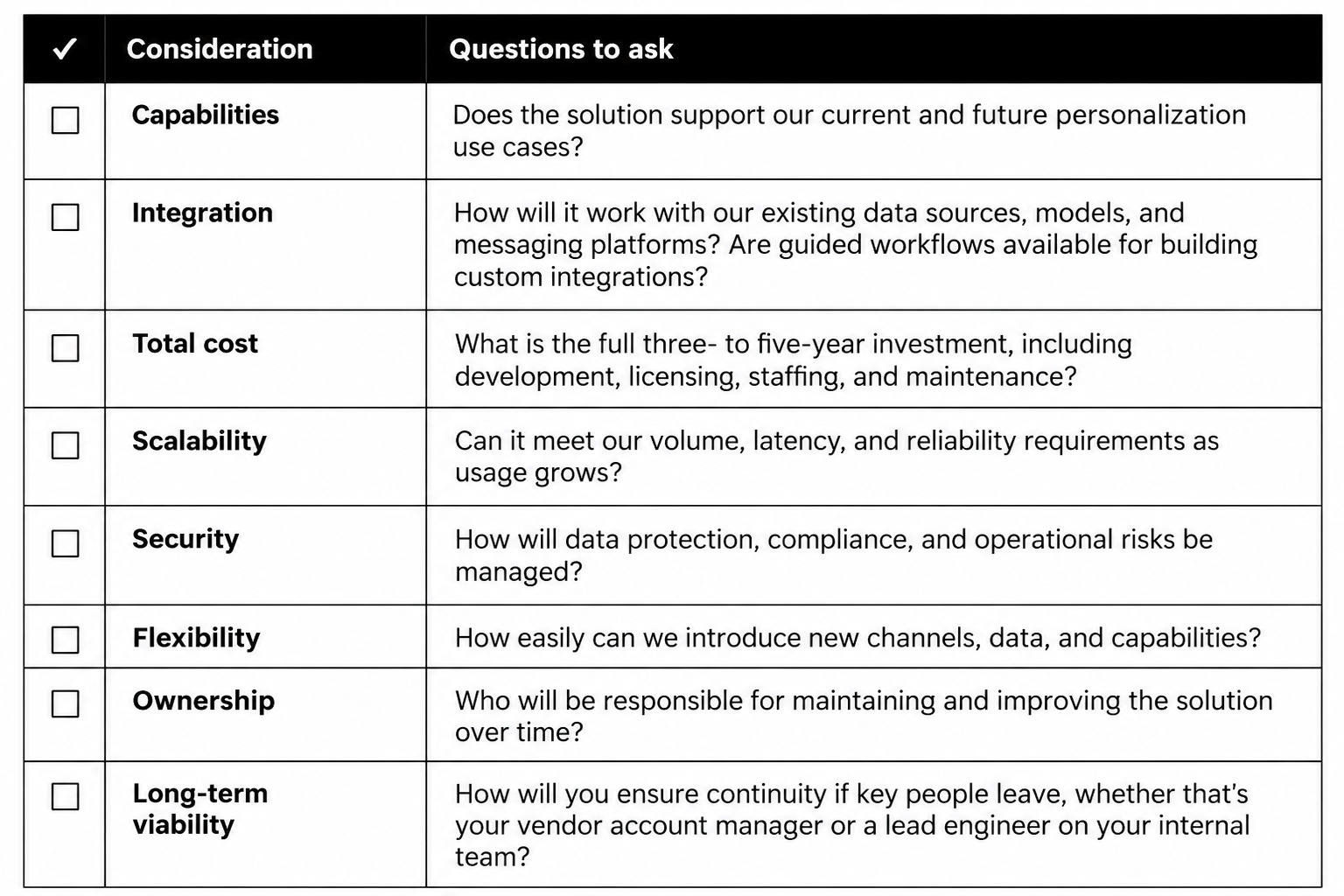
Your Build vs. Buy Evaluation Checklist
Before making a decision, use these questions to assess both approaches against your organization’s requirements.
Where Movable Ink Fits
For organizations considering a purpose-built platform, Movable Ink provides content personalization and AI decisioning capabilities that work alongside existing marketing technology, including CDPs, data warehouses, and messaging and orchestration platforms.
Assembling personalized content
Movable Ink enables marketing teams to create dynamic, personalized content across email, mobile, and web using existing customer, product, and contextual data.
With no-code creative tools, marketers can build and manage personalized content experiences without relying on developers to create and maintain individual variations.
This gives marketing teams more independence in campaign execution while IT maintains oversight of data connectivity and governance.
AI-powered decisioning at scale
Movable Ink uses AI to determine the content, timing, and frequency of marketing communications based on individual customer behavior and business-defined guidelines.
With a content-first approach, Da Vinci uses multi-armed bandit and transformer models to determine which experiences are most relevant to each customer, balancing immediate performance with long-term engagement. These capabilities extend across email, push notifications, and mobile messaging.
Organizations can also incorporate their own predictive scores into Da Vinci's decisioning, allowing them to build on their existing data science investments.
Built for enterprise requirements
Movable Ink maintains a SOC 2 Type II report and ISO 27001 and ISO 27701 certifications, with supporting documentation available through its Trust Center.
With more than 2 trillion impressions served and 99.9% uptime, Movable Ink has demonstrated its ability to support marketing at scale, including during peak periods.
For IT teams, this means less technology to build and maintain internally, while still making use of existing data infrastructure and marketing tools.