ESP-First Marketing Is Holding You Back: Here’s What to Do Instead
Andrew LeClair
|
Senior Director, Product Marketing
January 15, 2026
Share
LinkedIn
X
Email
Copy URL
Copy Page
Open in ChatGPT
Open in Claude
IN A NUTSHELL
• ESP-first marketing optimizes campaigns, not customer experiences • Static segments can’t keep up with real-time customer context • Experience-first approaches assemble content dynamically at the moment of engagement • Modular, data-driven content scales personalization across channels
As marketers, our campaigns are only as effective as the systems behind them. And while formats and features have evolved, the underlying go-to-market motions haven’t changed much in decades. Pick a product. Build a segment. Send everyone the same message. Repeat.
The problem is that every one of those steps (and the technology that supports them) was designed to meet the needs of marketers, not the people on the other side of the screen. Especially today’s audience. They don’t move neatly through journeys and campaigns. They jump between channels and devices. Their context changes by the minute. And they expect experiences on their terms, not ours.
Instead of being constrained by what traditional solutions allow, imagine rethinking your approach entirely. What if you didn’t have to start with a campaign, but instead could start with a customer? Imagine iIdentifying their needs in the moment, and having the content within every message automatically adapt to meet them wherever and whenever they choose to engage.
Here’s how to make the shift.
Shift From Static Experiences to Dynamic, Modular Content
The first step is redefining what an “experience” actually is.
In an ESP-first world, marketers manually create static, end-to-end experiences for every segment, channel, and campaign individually. Not only is this impossible to scale, it also means content is often finalized weeks or even months before anyone ever sees it. Once it’s sent, you’re locked in. There’s no way to account for changes in customer behavior, preferences, or context between send and the moment somebody actually engages.
An experience-first approach flips this model.
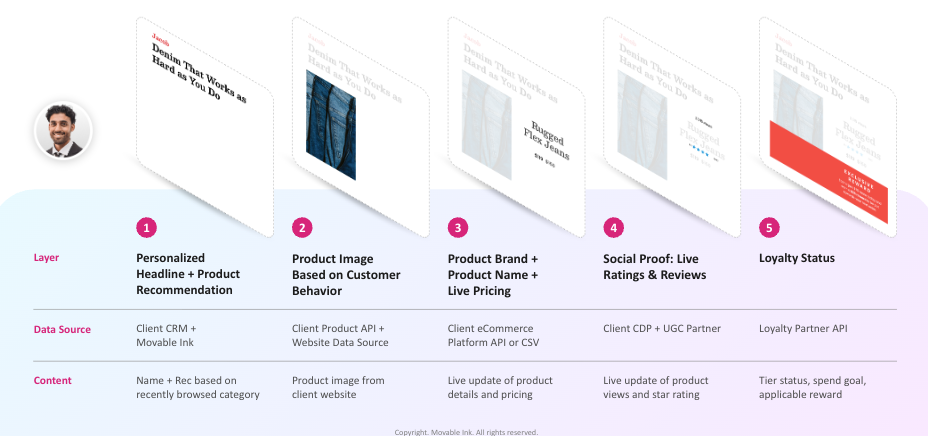
Instead of treating an experience as a single, fixed asset, it becomes a collection of modular moments—each tailored to the individual in real time. In other words, this isn’t one experience. It’s a composite of five smaller experiences that can be dynamically populated whenever someone chooses to engage.
One year can change everything.
Brands like UScellular, Bob Evans, and TastyTrade didn’t wait years to see results. Download the lookbook to see how they did it in just 12 months.
Populate Each Section by Transforming Data From Any Source
In an experience-first world, composite images aren’t limited to the data sitting inside your ESP or to simple text swaps. You can pull in multiple data points from multiple sources, all within a single experience, and apply different layers of targeting logic in one send.
For example, a single experience can come together in five layers:
A personalized headline and product recommendation The headline is tailored using CRM data pulled in via API, paired with a product recommendation based on each customer’s browsing behavior—all styled in your brand’s custom font.
A dynamically generated product image The experience pulls in a product image directly from your website, showing the exact item a customer has already shown interest in.
Real-time product details Ecommerce APIs populate live information like pricing, availability, and other key product details at the moment of engagement.
Up-to-date ratings and reviews Ratings and reviews are pulled in from your CDP and UGC partners, giving customers timely social proof when it matters most.
Live loyalty status and offers Loyalty progress is visualized in real time, showing how close someone is to their next reward and surfacing an offer tied to their current tier.
Whether you’re using behavioral, contextual, customer, or business data (or all of the above) the personalization possibilities are endless. What matters most is this: the experience updates itself.
Every time a customer re-engages, the content automatically refreshes to reflect any changes in their context or in your business since the last interaction. If a product has already been purchased, it’s swapped out. If pricing, inventory, or ratings change, the experience updates instantly, no campaign redeploy required.
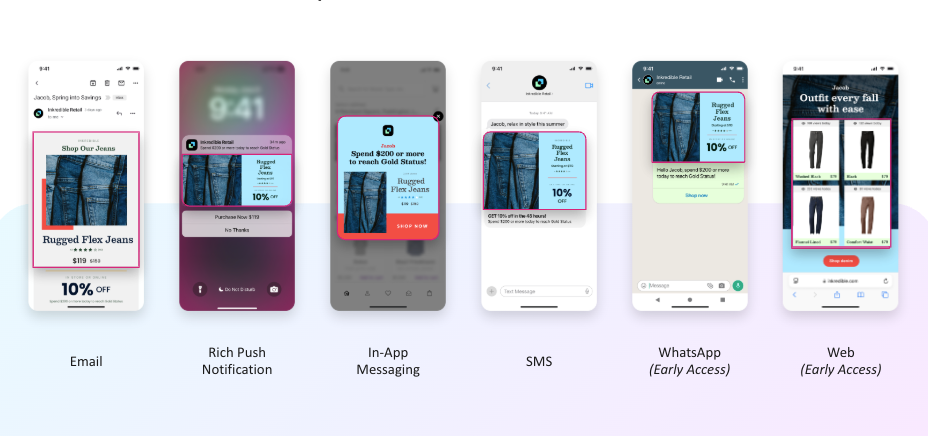
The beauty of this approach is that once built, you can automatically use and reuse that content block across any channel and campaign.
That means your teams no longer spend days or weeks rebuilding every single piece of content for every single channel, segment, and campaign. And your customers get the consistent, connected, customized experience that they’re after.
What’s the Difference?
With an ESP-first approach the “personalized” content a customer sees is driven by the segment they’ve been placed into and is finalized before they ever engage. With an experience-first approach, each customer is evaluated individually, and content is generated in the moment, reflecting their current situation, not a static snapshot.
ESP-first thinking limits you to the data available inside a single platform. Experience-first brings together signals from multiple data sources into one cohesive experience.
Why It Matters
At the end of the day, this shift changes how you show up for customers. You design content once, then use a single strategy to determine what each customer sees, wherever they interact with your brand.
It’s the difference between sending messages and delivering moments customers crave.
Share
LinkedIn
X
Email
Copy URL
Copy Page
Open in ChatGPT
Open in Claude
Related Resources
Maven of the Month: An Interview with Natalia Moncanut
Activate your data into personalized content in any customer engagement. Get a demo to see why the world’s most innovative brands rely on Movable Ink to drive customer engagement and accelerate their marketing performance.







%20copy.png)

.jpeg)
.png)
.png)
.png)

.png)


